- October 12, 2026
- Komlan AVOUZOUKPO
Introduction
Running a small business in the United States often means balancing limited resources with growing customer expectations. Owners and employees manage sales, marketing, customer service, accounting, and daily operations—sometimes with very little time left for strategic growth.
Artificial intelligence (AI) offers practical ways to reduce repetitive work, organize information, and improve decision-making. However, adopting AI successfully requires more than subscribing to a popular tool.
Many entrepreneurs want to know how to implement artificial intelligence in business without overspending, compromising customer data, or disrupting existing operations.
The good news is that small businesses do not necessarily need large technology budgets or dedicated AI research teams to get started.
By identifying a specific problem, choosing suitable tools, testing results, and training employees, organizations can introduce AI gradually and responsibly.
This guide explains how American small businesses can plan, implement, evaluate, and maintain AI solutions while focusing on productivity, security, affordability, and sustainable growth.
What Is Artificial Intelligence Implementation in Business?
Artificial intelligence implementation is the process of introducing AI-powered technologies into an organization’s operations to accomplish specific business objectives.
These technologies can analyze data, understand language, identify patterns, generate content, and support decisions.
For small businesses, AI implementation might involve connecting an intelligent customer service assistant to a website, automating document processing, or using predictive analytics to improve inventory planning.
How Does Business AI Work?
Most business AI applications involve four fundamental components.
Data: Information used by the system, such as customer questions, sales records, or approved business documents.
AI models: Software trained to identify patterns, produce predictions, classify information, or generate responses.
Business integration: Connections between the AI application and existing systems, such as CRM platforms, websites, and accounting software.
Human oversight: Employees who verify results, manage exceptions, and remain accountable for business decisions.
Practical Example: AI for a Small Retail Business
Imagine a small retailer in Austin, Texas, receiving frequent customer questions about store hours, product availability, and shipping policies.
Employees currently answer these inquiries manually.
The company could implement an AI-powered website assistant that retrieves answers from an approved information database.
Customers receive quicker responses to routine questions, while employees handle more complicated requests.
Before launching, the retailer should test the assistant’s accuracy, ensure it does not disclose sensitive information, and provide a clear path to human support.
This example illustrates a fundamental principle: effective AI implementation starts with a real business problem rather than a technology trend.
Why Should US Small Businesses Implement Artificial Intelligence?
AI adoption can provide meaningful benefits when businesses choose appropriate applications and monitor results.
1. Improve Employee Productivity
Small business employees frequently manage several responsibilities simultaneously.
AI can assist with repetitive activities such as summarizing meetings, organizing documents, drafting routine communications, and retrieving information.
For example, a consulting company might use an approved AI assistant to prepare first drafts of project summaries.
Employees would review the drafts before sharing them with clients.
This can reduce administrative work and allow more time for activities requiring professional judgment.
2. Reduce Avoidable Operational Expenses
Some business processes require substantial manual effort.
AI-enabled automation may reduce repetitive data entry, improve information routing, and help employees complete routine tasks more efficiently.
However, businesses must compare potential savings with software subscriptions, integration expenses, training, and ongoing maintenance.
A lower workload does not automatically translate into lower cash expenses.
3. Improve Customer Service
AI-powered customer support systems can help businesses organize inquiries, answer common questions, and provide assistance beyond standard operating hours.
These tools are particularly useful when customers repeatedly request similar information.
Human representatives should remain available for sensitive, unusual, or complex situations.
4. Support Better Business Decisions
AI-powered analytics can help identify sales patterns, operational trends, and potential anomalies.
A retailer might use forecasting software to estimate seasonal demand, while a service provider could analyze appointment trends.
These insights can support planning, but predictions should be evaluated against actual business conditions.
5. Support Business Scalability
As a company grows, its administrative workload often increases.
AI-assisted workflows can help businesses process larger volumes of routine information without expanding manual work at the same rate.
Scalability depends on reliable infrastructure, data quality, integration, and employee readiness.
6. Strengthen Digital Capabilities
AI implementation can encourage businesses to modernize outdated processes and improve how their software systems work together.
It may also create opportunities for new digital services and customer experiences.
The US Small Business Administration recommends that small businesses start with manageable AI applications and evaluate their usefulness before expanding.
Source: https://www.sba.gov/counseling/manage-your-business/
Main Artificial Intelligence Solutions for Small Businesses
Small businesses can adopt AI through several practical applications.
The most suitable solution depends on their industry, budget, customer needs, and existing technology.
| AI Solution | Practical Application | Potential Business Benefit |
|---|---|---|
| AI customer service | Answering common customer questions | Faster responses |
| Intelligent document processing | Extracting invoice and form information | Less manual data entry |
| AI marketing assistance | Drafting campaigns and product descriptions | More efficient content creation |
| Predictive analytics | Forecasting sales and inventory demand | Improved planning |
| AI knowledge assistants | Searching approved internal documents | Faster information retrieval |
| AI cybersecurity support | Prioritizing suspicious activity | Better security monitoring |
AI-Powered Customer Service
Small businesses can use AI assistants to answer routine questions, organize requests, and route inquiries.
An effective solution should retrieve information from reliable sources and clearly identify situations requiring human intervention.
AI for Marketing and Sales
Marketing teams can use AI to brainstorm campaign ideas, draft social media content, organize customer research, and analyze performance data.
Sales teams can use AI-assisted CRM features to summarize customer interactions and organize follow-up activities.
All customer-facing content should be reviewed before publication.
AI for Accounting and Administration
AI-enabled document processing can help extract information from invoices, receipts, and other business records.
Businesses should validate extracted information before using it for financial reporting or payments.
AI for Inventory and Operations
Retailers and distributors can use predictive models to estimate demand based on historical sales and other relevant information.
Forecasts may improve purchasing decisions, but unexpected market conditions can reduce their accuracy.
AI for Internal Knowledge Management
A small company can use an AI assistant to search approved policies, procedures, product documentation, and training materials.
Access permissions must ensure employees only receive information they are authorized to view.
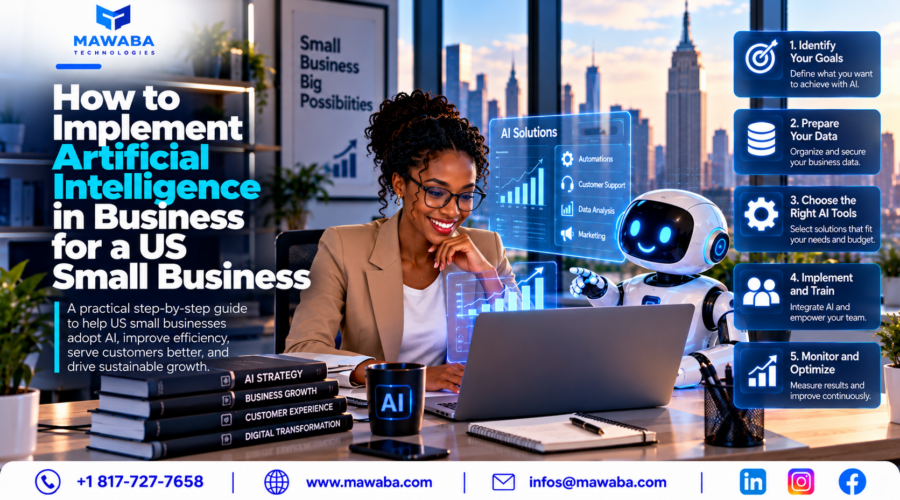
How to Implement Artificial Intelligence in a Small Business: Step-by-Step
A structured implementation process helps reduce unnecessary expenses and operational risks.
Step 1: Identify the Business Problem
Before selecting an AI tool, determine what you want to improve.
Ask yourself:
-
Which activities consume the most employee time?
-
Where do mistakes or delays occur frequently?
-
Which customer requests are repetitive?
-
What information is difficult to access?
-
Which processes limit business growth?
Choose a problem with measurable consequences.
For example, instead of setting a vague objective such as “use AI in customer service,” define a goal such as reducing the average handling time for routine inquiries while maintaining customer satisfaction.
Step 2: Assess Your Current Business Processes
Review how employees currently complete the selected task.
Document the workflow, software applications, information sources, and decision points.
Determine whether the process is already efficient.
Sometimes conventional automation or a simple software improvement is more appropriate than AI.
Step 3: Evaluate Data Readiness and Security
Identify the information the AI system requires.
Check whether your data is accurate, current, properly organized, and legally available for the intended purpose.
Avoid entering confidential customer information into unapproved AI applications.
Review applicable privacy requirements, vendor contracts, and internal access policies.
Step 4: Define Your Budget and Requirements
Determine how much your business can reasonably invest.
Consider:
-
Software subscriptions.
-
Usage-based API charges.
-
Integration and development expenses.
-
Employee training.
-
Security controls.
-
Maintenance and technical support.
Establish the expected business benefit and decide how it will be measured.
Step 5: Select the Right AI Technology
Compare existing AI applications, AI features within current business software, and custom development options.
Evaluate each solution based on functionality, reliability, security, pricing, integration, and vendor support.
For many small businesses, an established software platform with built-in AI features may be easier to manage than a custom application.
Step 6: Develop a Small Pilot Project
Begin with a limited test rather than deploying AI throughout the company.
For example, introduce an AI assistant to one internal team or automate one document-processing workflow.
Set clear performance indicators before starting.
A pilot should help answer whether the solution works reliably and delivers enough value to justify expansion.
Step 7: Test Accuracy, Privacy, and Reliability
Evaluate the AI system using realistic scenarios.
Include incomplete information, unusual requests, incorrect data, and situations where the system should ask for human assistance.
Check whether the application produces inaccurate responses, exposes restricted information, or behaves unexpectedly.
Record problems and resolve significant issues before deployment.
Step 8: Train Employees and Deploy Gradually
Employees need to understand what the AI system can and cannot do.
Provide training on acceptable use, data protection, result verification, and escalation procedures.
Introduce the technology gradually so teams can adapt and provide feedback.
Step 9: Monitor Performance and Improve
AI implementation does not end when the system becomes operational.
Monitor accuracy, costs, user feedback, business outcomes, and security.
Review the system whenever business requirements, software integrations, or vendor policies change.
Expand AI adoption only when the results support further investment.
How Much Does AI Implementation Cost for a US Small Business?
AI implementation costs vary considerably.
A business using an existing subscription-based tool may face relatively modest initial expenses, while a custom AI application integrated with several systems can require substantial development and maintenance.
Main Cost Factors
Software licensing: Monthly or annual subscription charges.
Usage fees: Costs based on the number of requests, processed documents, or computing resources.
Integration: Connecting AI applications with existing business software.
Data preparation: Organizing and validating information.
Training: Helping employees use the system effectively.
Security: Protecting sensitive data and controlling access.
Maintenance: Monitoring performance and updating the solution.
How to Calculate AI Return on Investment
A simple ROI calculation is:
ROI (%) = [(Financial Benefits − Total Costs) ÷ Total Costs] × 100
Consider a hypothetical small business that invests $6,000 in an AI-assisted workflow.
Over one year, it identifies $9,000 in verified financial benefits.
Its estimated ROI would be:
ROI = [($9,000 − $6,000) ÷ $6,000] × 100 = 50%
This example is illustrative, not a promised result.
The calculation should include relevant operating expenses and avoid treating every hour saved as a direct financial saving.
Metrics Small Businesses Should Monitor
Useful performance indicators include:
-
Time spent completing routine tasks.
-
Cost per processed transaction.
-
Customer response time.
-
Accuracy and error rates.
-
Employee satisfaction.
-
Customer satisfaction.
-
Software and maintenance expenses.
-
Revenue associated with improved workflows.
Best Practices and Common AI Implementation Mistakes
Best Practices for Small Businesses
Start with one use case. A focused project is easier to evaluate and manage.
Choose measurable objectives. Establish baseline performance before introducing AI.
Protect customer information. Review vendor policies, security settings, and access permissions.
Keep humans involved. Require appropriate review of important decisions and customer-facing outputs.
Train employees. Explain both the capabilities and limitations of the technology.
Review performance regularly. Monitor accuracy, costs, and unexpected behavior.
The National Institute of Standards and Technology provides a voluntary AI Risk Management Framework to support responsible AI development and use.
Source: https://www.nist.gov/itl/ai-risk-management-framework
Common Mistakes to Avoid
| Common Mistake | Better Approach |
|---|---|
| Implementing AI without a clear purpose | Define a measurable business problem |
| Purchasing overly complex technology | Compare simpler solutions first |
| Ignoring data privacy | Establish security and access controls |
| Trusting every AI response | Require verification |
| Failing to train employees | Provide practical training |
| Expanding too quickly | Validate a pilot before scaling |
| Ignoring maintenance costs | Calculate total cost of ownership |
Industry Applications of Artificial Intelligence for US Small Businesses
Retail and E-Commerce
Small retailers can use AI for product recommendations, customer assistance, inventory forecasting, and marketing content.
Healthcare Practices
Healthcare businesses can explore AI for administrative scheduling, documentation support, and operational planning.
Organizations handling protected health information must assess applicable HIPAA obligations and vendor arrangements before using AI tools.
Financial and Accounting Services
Accounting firms can use AI to support document classification, information retrieval, and administrative workflows.
Professional review remains essential for financial reporting and client advice.
Logistics and Transportation
Small logistics companies can use predictive analytics to support delivery planning, vehicle maintenance, and demand forecasting.
Education and Training
Training providers can use AI to organize educational materials, prepare practice exercises, and assist with administrative tasks.
Human review is important for accuracy and instructional quality.
Professional Services
Consulting agencies, marketing firms, and other service businesses can use AI for research assistance, document preparation, project summaries, and internal knowledge management.
Technology Startups
Startups can integrate AI into software products, automate internal workflows, and assist development teams with testing and documentation.
Future Trends and Opportunities for Small Business AI
Artificial intelligence continues to evolve, creating opportunities for organizations that approach adoption carefully.
AI Agents and Workflow Automation
AI agents can perform sequences of tasks using connected software and approved information.
For example, an agent might organize incoming service requests, retrieve relevant documentation, and prepare responses for employee approval.
Businesses should restrict system permissions and require human confirmation for consequential actions.
AI Features in Everyday Business Software
More business applications are incorporating AI-assisted features.
For small businesses, this can make adoption easier because employees may be able to use AI within familiar tools.
However, companies should review licensing, privacy settings, and vendor dependencies.
Industry-Specific AI Applications
Specialized AI tools may address particular industry workflows, terminology, and operational requirements.
Small businesses should compare these solutions against general-purpose alternatives before investing.
Responsible AI Governance
Privacy, cybersecurity, accuracy, and accountability will remain important considerations as AI becomes more deeply integrated into business processes.
NIST’s AI Risk Management Framework and supporting resources provide useful guidance for organizations developing risk management practices.
Human-AI Collaboration
AI is likely to remain most useful in many small-business settings when it complements employees rather than operating without supervision.
Businesses can prepare by improving digital skills, documenting workflows, and developing clear technology policies.
These developments represent opportunities, not guarantees of future performance or profitability.
Why Choose Mawaba Technologies?
Implementing artificial intelligence requires a clear understanding of business needs, existing technology, operational requirements, and long-term objectives.
Mawaba Technologies is an information technology and digital solutions company with a presence in the United States and Togo.
The company focuses on digital and IT solutions adapted to business requirements.
For small businesses considering AI adoption, working with a technology partner can help clarify project requirements, assess existing systems, and identify appropriate digital solutions.
A structured technology discussion can address integration needs, security considerations, implementation priorities, and future scalability.
Mawaba Technologies encourages businesses to approach digital transformation with clear objectives and practical expectations.
Whether your organization is evaluating its first AI application or planning broader technology modernization, the most important starting point is understanding the problem you want to solve.
Explore your digital transformation opportunities with Mawaba Technologies.
Contact Mawaba Technologies
Ready to explore artificial intelligence or other digital solutions for your small business?
Contact Mawaba Technologies to discuss your technology requirements and request a consultation.
Mawaba Technologies — United States
Address: 5900 Balcones Drive, Suite 100, Austin, Texas 78731, USA
Phone: +1 817-727-7658
Mawaba Technologies — Togo
Address: 659R+62W, Villa Simtako, Quartier Agoè, Lomé, Togo
Phone: +228 73 25 81 41
Official Website: https://mawaba.com/
Email: infos@mawaba.com
Start Your AI Implementation Journey
Your business does not need to transform every process overnight.
Start by identifying one operational challenge and exploring the most appropriate digital solution.
Visit https://mawaba.com/ or email infos@mawaba.com to discuss your business needs.
Conclusion
Learning how to implement artificial intelligence in business can help US small-business owners make informed decisions about technology investment.
AI offers opportunities to improve productivity, streamline repetitive tasks, strengthen customer service, and support better operational planning.
However, successful implementation depends on clear objectives, reliable data, suitable tools, employee training, cybersecurity, and continuous evaluation.
Small businesses should begin with manageable projects, measure real outcomes, and expand only when the results justify further investment.
Artificial intelligence is most valuable when it solves a genuine business problem rather than adding unnecessary complexity.
For entrepreneurs and growing organizations exploring AI adoption or digital modernization, Mawaba Technologies welcomes the opportunity to discuss practical technology requirements and potential solutions.
Frequently Asked Questions About AI Implementation for Small Businesses
1. How can a small business start implementing artificial intelligence?
A small business should begin by identifying a repetitive or costly operational task. Next, it should evaluate available AI tools, review data security requirements, and launch a limited pilot. Measuring the results before expanding helps reduce financial and operational risks.
2. How much does AI implementation cost for a small business in the United States?
Costs depend on the selected technology, number of users, integrations, data requirements, and maintenance. Existing subscription-based AI tools may be relatively affordable, while custom development can require a larger investment. Businesses should calculate total costs rather than focusing only on subscription prices.
3. What are the best AI applications for small businesses?
Common applications include customer support assistants, document processing, marketing assistance, internal knowledge search, sales analysis, and inventory forecasting. The best choice depends on the company’s industry, existing workflows, and measurable business objectives.
4. Do small businesses need technical experts to implement AI?
Not always. Many existing AI tools are designed for users without advanced technical skills. However, custom integrations, sensitive data processing, complex automation, and security-sensitive applications may require professional IT support.
5. How long does it take to implement artificial intelligence in a small business?
A simple pilot using an existing application may take days or weeks. A custom system involving multiple integrations, data preparation, and extensive testing can take several months or longer. The timeline depends on complexity and organizational readiness.
6. Is artificial intelligence safe for small-business customer data?
AI can be used responsibly when businesses apply suitable security controls. Organizations should evaluate vendor privacy policies, restrict access to sensitive information, and avoid entering confidential data into unapproved tools. Additional legal requirements may apply depending on the industry and location.
7. Can AI replace employees in a small business?
AI can automate or assist with selected tasks, but it does not automatically replace entire jobs. Many activities still require human judgment, customer relationships, professional expertise, and accountability. Small businesses should focus on improving workflows and preparing employees to work effectively with AI.
8. How can a small business measure the success of AI implementation?
Businesses can compare performance before and after implementation using metrics such as processing time, operating costs, accuracy, customer satisfaction, and employee productivity. Financial benefits should be evaluated against software, integration, training, and maintenance expenses.